Submitted by Albert Sub Yun
on
SPRING 2022 COURSES
L ARCH 322 | Intro to Planting Design
Intro to Design with Living Materials
Kristi M. Park, RLA
3 credits, VLPA
MW 11:30a – 12:50, In-Person/Hybrid
SLN: 16115
Questions? contact Jennie Li, jencyli@uw.edu
As urban and rural areas continue to accommodate an ever-growing population, we must also reckon with harmful development patterns from the past. How do we balance equitable and healthy ecological and human health? We will tackle this question through an unsung heroic method; designing with living materials (aka. plants).
This quarter, we will continuously jump between global and site- specific scales through weekly exercises, diagramming, sketching, and observations. As an introductory course, prior knowledge of plants, space, drawing, design, or ecology is not required. However, a willingness to explore, discuss, exercise your imagination, think afresh, and work hard is essential.
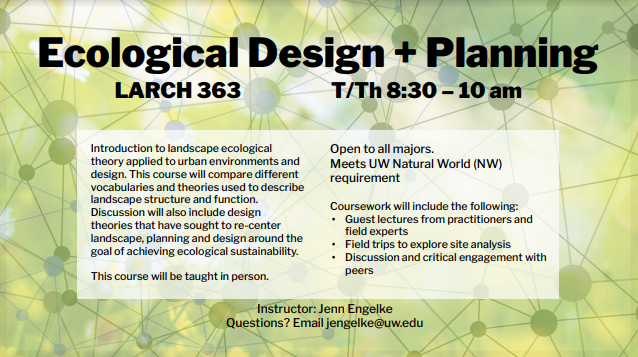
L ARCH 363 | Ecological Design + Planning
(undergraduates only)
Jenn Engelke
3 credits, NW, BLA major requirement
T, Th 8:30-10 AM, In-Person
SLN:16116
Questions? Email jengelke@uw.edu
Introduction to landscape ecological theory applied to urban environments and design. This course will compare different vocabularies and theories used to describe landscape structure and function. Discussion will also include design theories that have sought to re-center landscape, planning and design around the goal of achieving ecological sustainability.
Coursework will include the following:
Intro to Design with Living Materials
Kristi M. Park, RLA
3 credits, VLPA
MW 11:30a – 12:50, In-Person/Hybrid
SLN: 16115
Questions? contact Jennie Li, jencyli@uw.edu
As urban and rural areas continue to accommodate an ever-growing population, we must also reckon with harmful development patterns from the past. How do we balance equitable and healthy ecological and human health? We will tackle this question through an unsung heroic method; designing with living materials (aka. plants).
This quarter, we will continuously jump between global and site- specific scales through weekly exercises, diagramming, sketching, and observations. As an introductory course, prior knowledge of plants, space, drawing, design, or ecology is not required. However, a willingness to explore, discuss, exercise your imagination, think afresh, and work hard is essential.
(undergraduates only)
Jenn Engelke
3 credits, NW, BLA major requirement
T, Th 8:30-10 AM, In-Person
SLN:16116
Questions? Email jengelke@uw.edu
Introduction to landscape ecological theory applied to urban environments and design. This course will compare different vocabularies and theories used to describe landscape structure and function. Discussion will also include design theories that have sought to re-center landscape, planning and design around the goal of achieving ecological sustainability.
Coursework will include the following:
- Guest lectures from practitioners and field experts
- Field trips to explore site analysis
- Discussion and critical engagement with peers
L ARCH 412 | Field Sketching, Line, Tone and Composition
Daniel Winterbottom
3 credits
T 11:30-2:20
SLN:16118
Questions? Email nina@u.washington.edu
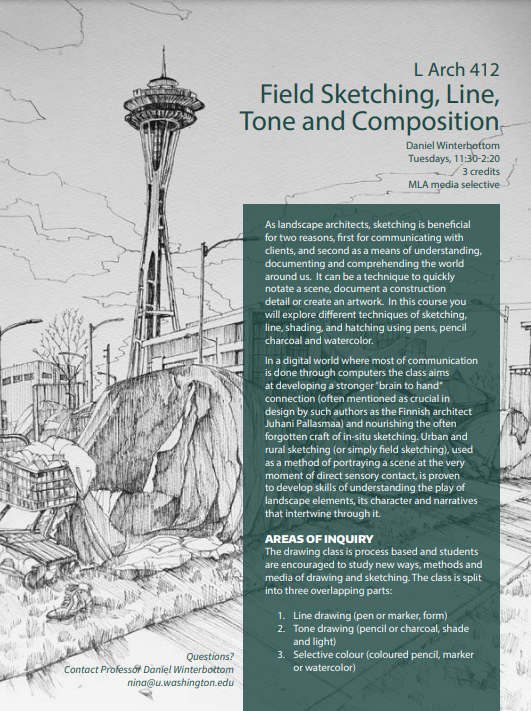
As landscape architects, sketching is beneficial for two reasons, first for communicating with clients, and second as a means of understanding, documenting and comprehending the world around us. It can be a technique to quickly notate a scene, document a construction detail or create an artwork. In this course you will explore different techniques of sketching, line, shading, and hatching using pens, pencil charcoal and watercolor.
In a digital world where most of communication is done through computers the class aims at developing a stronger “brain to hand“ connection (often mentioned as crucial in design by such authors as the Finnish architect Juhani Pallasmaa) and nourishing the often forgotten craft of in-situ sketching. Urban and rural sketching (or simply field sketching), used as a method of portraying a scene at the very moment of direct sensory contact, is proven to develop skills of understanding the play of landscape elements, its character and narratives that intertwine through it.
AREAS OF INQUIRY
The drawing class is process based and students are encouraged to study new ways, methods and media of drawing and sketching. The class is split into three overlapping parts:
Maria C.Taylor, Ph.D
5 credits, I&S, Optional Writing, BLA/MLA History requirement
MWF 11:30-12:50
SLN:16122
Synchronous
Questions on content? Contact Dr. Taylor, m3taylor@uw.edu
Need an add code? Contact Jennie Li, jencyli@uw.edu
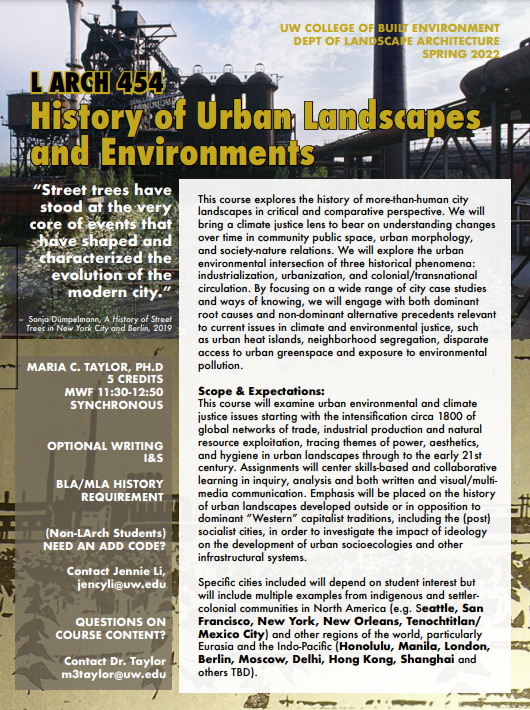
“Street trees have stood at the very core of events that have shaped and characterized the evolution of the modern city.”
– Sonja Dümpelmann, A History of Street Trees in New York City and Berlin, 2019
This course explores the history of more-than-human city landscapes in critical and comparative perspective. We will bring a climate justice lens to bear on understanding changes over time in community public space, urban morphology, and society-nature relations. We will explore the urban environmental intersection of three historical phenomena: industrialization, urbanization, and colonial/transnational circulation. By focusing on a wide range of city case studies and ways of knowing, we will engage with both dominant root causes and non-dominant alternative precedents relevant to current issues in climate and environmental justice, such as urban heat islands, neighborhood segregation, disparate access to urban greenspace and exposure to environmental pollution.
Scope & Expectations:
This course will examine urban environmental and climate justice issues starting with the intensification circa 1800 of global networks of trade, industrial production and natural resource exploitation, tracing themes of power, aesthetics, and hygiene in urban landscapes through to the early 21st century. Assignments will center skills-based and collaborative learning in inquiry, analysis and both written and visual/multi- media communication. Emphasis will be placed on the history of urban landscapes developed outside or in opposition to dominant “Western” capitalist traditions, including the (post) socialist cities, in order to investigate the impact of ideology on the development of urban socioecologies and other infrastructural systems.
Specific cities included will depend on student interest but will include multiple examples from indigenous and settler- colonial communities in North America (e.g. Seattle, San Francisco, New York, New Orleans, Tenochtitlan/ Mexico City) and other regions of the world, particularly Eurasia and the Indo-Pacific (Honolulu, Manila, London, Berlin, Moscow, Delhi, Hong Kong, Shanghai and others TBD).
Daniel Winterbottom
3 credits
T 11:30-2:20
SLN:16118
Questions? Email nina@u.washington.edu
As landscape architects, sketching is beneficial for two reasons, first for communicating with clients, and second as a means of understanding, documenting and comprehending the world around us. It can be a technique to quickly notate a scene, document a construction detail or create an artwork. In this course you will explore different techniques of sketching, line, shading, and hatching using pens, pencil charcoal and watercolor.
In a digital world where most of communication is done through computers the class aims at developing a stronger “brain to hand“ connection (often mentioned as crucial in design by such authors as the Finnish architect Juhani Pallasmaa) and nourishing the often forgotten craft of in-situ sketching. Urban and rural sketching (or simply field sketching), used as a method of portraying a scene at the very moment of direct sensory contact, is proven to develop skills of understanding the play of landscape elements, its character and narratives that intertwine through it.
AREAS OF INQUIRY
The drawing class is process based and students are encouraged to study new ways, methods and media of drawing and sketching. The class is split into three overlapping parts:
- Line drawing (pen or marker, form)
- Tone drawing (pencil or charcoal, shade and light)
- Selective colour (coloured pencil, marker, or watercolor)
Maria C.Taylor, Ph.D
5 credits, I&S, Optional Writing, BLA/MLA History requirement
MWF 11:30-12:50
SLN:16122
Synchronous
Questions on content? Contact Dr. Taylor, m3taylor@uw.edu
Need an add code? Contact Jennie Li, jencyli@uw.edu
“Street trees have stood at the very core of events that have shaped and characterized the evolution of the modern city.”
– Sonja Dümpelmann, A History of Street Trees in New York City and Berlin, 2019
This course explores the history of more-than-human city landscapes in critical and comparative perspective. We will bring a climate justice lens to bear on understanding changes over time in community public space, urban morphology, and society-nature relations. We will explore the urban environmental intersection of three historical phenomena: industrialization, urbanization, and colonial/transnational circulation. By focusing on a wide range of city case studies and ways of knowing, we will engage with both dominant root causes and non-dominant alternative precedents relevant to current issues in climate and environmental justice, such as urban heat islands, neighborhood segregation, disparate access to urban greenspace and exposure to environmental pollution.
Scope & Expectations:
This course will examine urban environmental and climate justice issues starting with the intensification circa 1800 of global networks of trade, industrial production and natural resource exploitation, tracing themes of power, aesthetics, and hygiene in urban landscapes through to the early 21st century. Assignments will center skills-based and collaborative learning in inquiry, analysis and both written and visual/multi- media communication. Emphasis will be placed on the history of urban landscapes developed outside or in opposition to dominant “Western” capitalist traditions, including the (post) socialist cities, in order to investigate the impact of ideology on the development of urban socioecologies and other infrastructural systems.
Specific cities included will depend on student interest but will include multiple examples from indigenous and settler- colonial communities in North America (e.g. Seattle, San Francisco, New York, New Orleans, Tenochtitlan/ Mexico City) and other regions of the world, particularly Eurasia and the Indo-Pacific (Honolulu, Manila, London, Berlin, Moscow, Delhi, Hong Kong, Shanghai and others TBD).
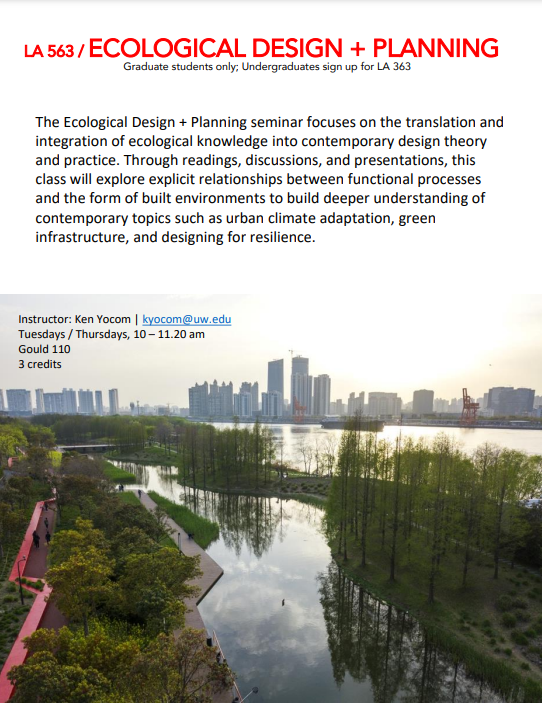
L ARCH 563 | Ecological Design + Planning
(graduates only)
Ken Yocom
3 credits
T, Th 10-11:20 AM
SLN:16131
Questions? Email kyocom@uw.edu
The Ecological Design + Planning seminar focuses on the translation and integration of ecological knowledge into contemporary design theory and practice. Through readings, discussions, and presentations, this class will explore explicit relationships between functional processes and the form of built environments to build deeper understanding of contemporary topics such as urban climate adaptation, green infrastructure, and designing for resilience.