Where Can Your Intellectual Curiosity Lead You in Political Science? The UW Department of Political Science is a great place to study the political economy of development with professors who conduct research on regions from Asia and the Middle East to Africa and Latin America.

A Question That Shaped a Career
As a college freshman, UW Political Science Professor Susan Whiting wondered how to meet the basic needs of the world’s then four-and-a-half billion people. To explore the question, she decided to study the most populous country at that time: China. That exploration has led her to learn Mandarin (it was her first class at 8:00am Monday morning on the first day of school as an undergrad at Yale), and it has taken her to China for research almost every year for the past forty years. She studied at Nanjing University in 1985, when, following China’s introduction of the “Reform and Opening” policy, the return of markets and private enterprise was just beginning. At that time, there were no private apartments to rent, buying a bicycle required a ration coupon, and it was hard to find many basic consumer products in the state-run stores in town.
Witnessing China's Transformation Firsthand
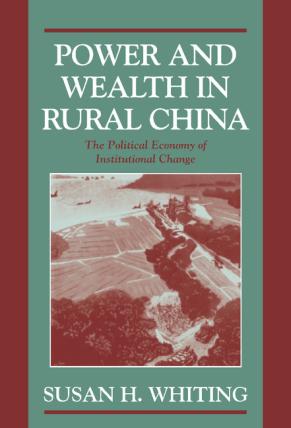
Fast forward only ten years, and non-state enterprises employing surplus labor from the farm sector and mobilizing capital from household savings in rural credit cooperatives began to fuel labor-intensive manufacturing for export in sectors like shoes and toys. This development inspired Whiting’s Ph.D. dissertation at the University of Michigan, which grew into her first book, Power and Wealth in Rural China. It tackles questions such as: what kinds of property rights could incentivize private entrepreneurs in a nominally Communist system to invest in fixed assets, and, as non-state firms became an increasingly important part of China’s economy, how did the party-state go about taxing them? Back then, surveys of firms and households in China were in their infancy; so, to write the book, Whiting spent about a year-and-a-half in China, interviewing hundreds of factory managers and local officials.
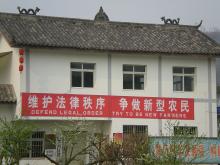
While finishing that project, Whiting observed a phenomenon that seemed surprising in a Leninist party-state: firms began to use law and courts to assert and try to defend their economic interests. As part of the reform process, the party-state began investing more in law as a tool of authoritarian governance.
China’s passage of its Land Management Law provided formal, legal backing for the forceful requisition of land by the state from rural villages for construction of industrial parks and for sale to urban real estate developers. At the same time, large-scale survey research became a possibility.
Forthcoming Book: Illiberal Law and Development
Surveying 1,800 households in three dozen villages throughout rural China, Whiting turned her focus to property rights in land—the most valuable asset of farm households. In her forthcoming book, Illiberal Law and Development, Whiting explains the role of land law in China’s breakneck urban and industrial expansion. The Chinese state claims legal authority to reassign land rights from the rural, agricultural sector to the urban, industrial sector. Not surprisingly, land takings generate significant social conflict. The state directed courts and petition offices to contain the unrest. On the one hand, construction of the legal system enhances trust in the state among the general public; at the same time, households that try to actually use law to defend their land rights remain dissatisfied and lose trust in the state.
Land grabbing is not unique to China. From Britain of the early 18th Century to contemporary India, land is a key factor in industrialization and urbanization. Illiberal Law and Development compare how these authoritarian and democratic regimes all used law to provide land for their respective industrial revolutions. However, China’s illiberal system of law—which lacks an independent judiciary, abjures private land rights, undergirds state more than market forces, and has failed to legislate for property taxes rather than land sales to fund local governments—contributed to the recent real estate bubble and property market crash.
The Next Frontier: Who Owns Water?
What’s next on the property rights research agenda: who owns water? Both the United States and China face water shortages. Who gets access to water resources is another key question in exploring how to meet the basic needs of the world’s now eight-plus billion people.