From Geography:
Dear Students,
Consider taking a GEOGRAPHY course to meet your SSc (Areas of Inquiry) requirements! Consider any one of the four courses outlined below (additional details about each course available on the attached flyers)!
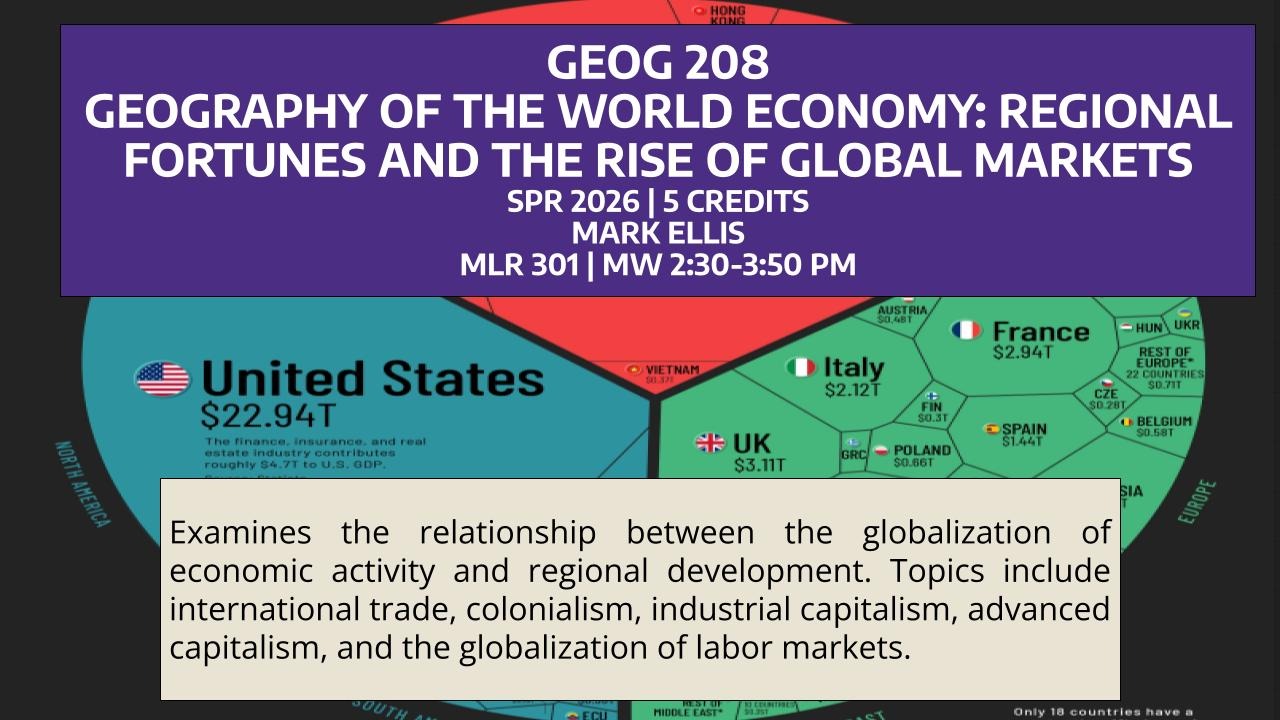
GEOG 208 Geography of the World Economy: Regional Fortunes and the Rise of Global Markets (5) SSc
Examines the relationship between the globalization of economic activity and regional development. Topics include international trade, colonialism, industrial capitalism, advanced capitalism, and the globalization of labor markets.
View course details in MyPlan: GEOG 208
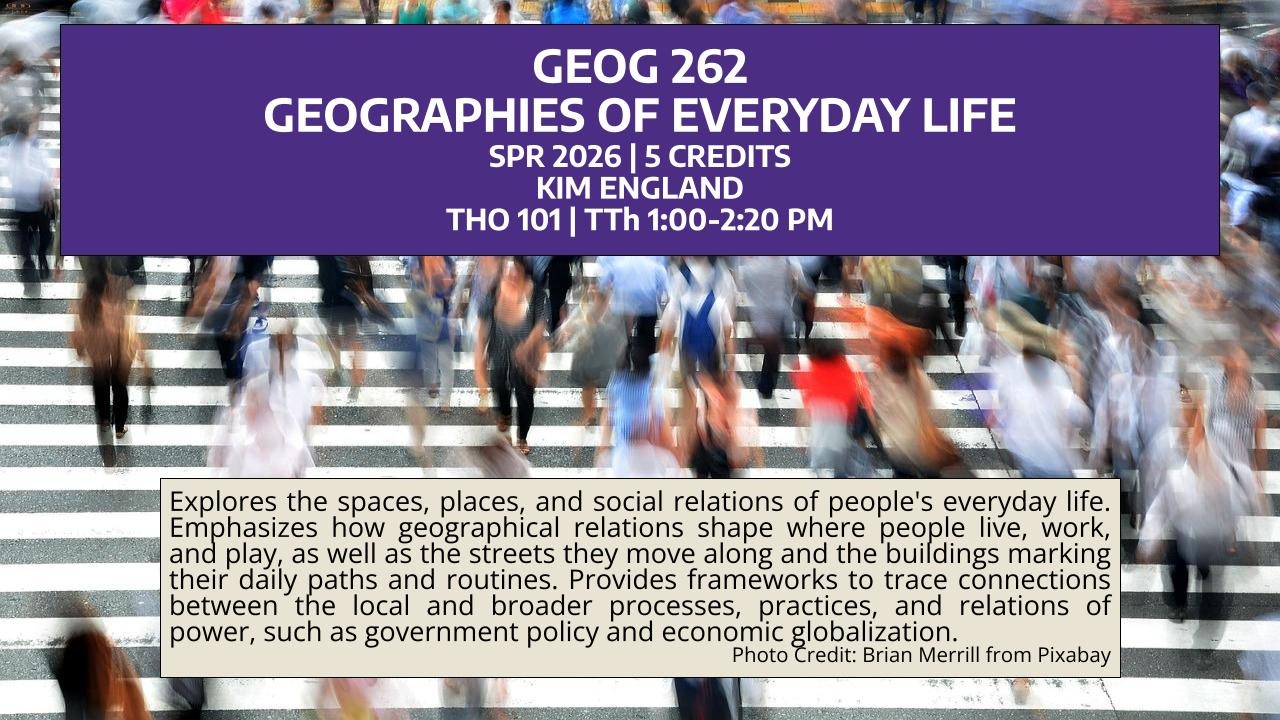
GEOG 262 Geographies of Everyday Life (5) SSc
Explores the spaces, places, and social relations of people's everyday life. Emphasizes how geographical relations shape where people live, work, and play, as well as the streets they move along and the buildings marking their daily paths and routines. Provides frameworks to trace connections between the local and broader processes, practices, and relations of power, such as government policy and economic globalization.
View course details in MyPlan: GEOG 262
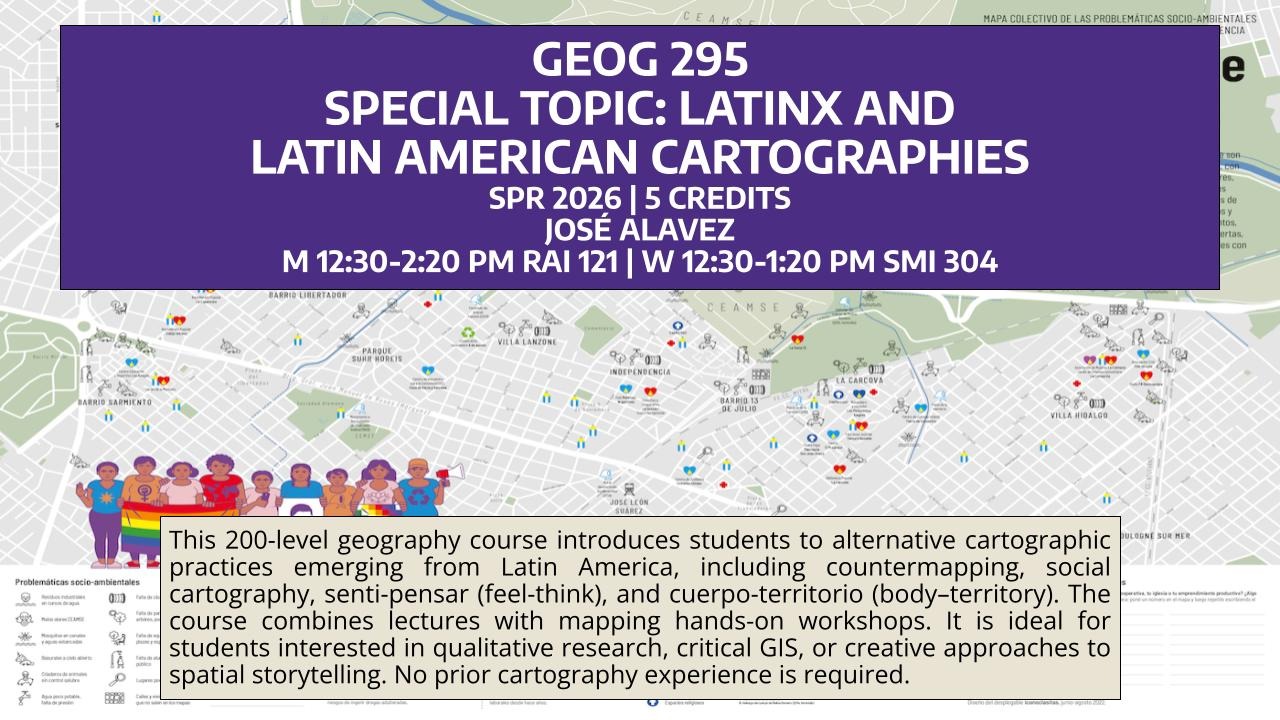
GEOG 295 Special Topics in Geography: Latinx and Latin American Cartographies (5) SSc
This 200-level geography course introduces students to alternative cartographic practices emerging from Latin America, including countermapping, social cartography, senti-pensar (feel-think), and cuerpo-territorio (body–territory). The course combines lectures with mapping hands-on workshops. It is ideal for students interested in qualitative research, critical GIS, or creative approaches to spatial storytelling. No prior cartography experience is required.
View course details in MyPlan: GEOG 295
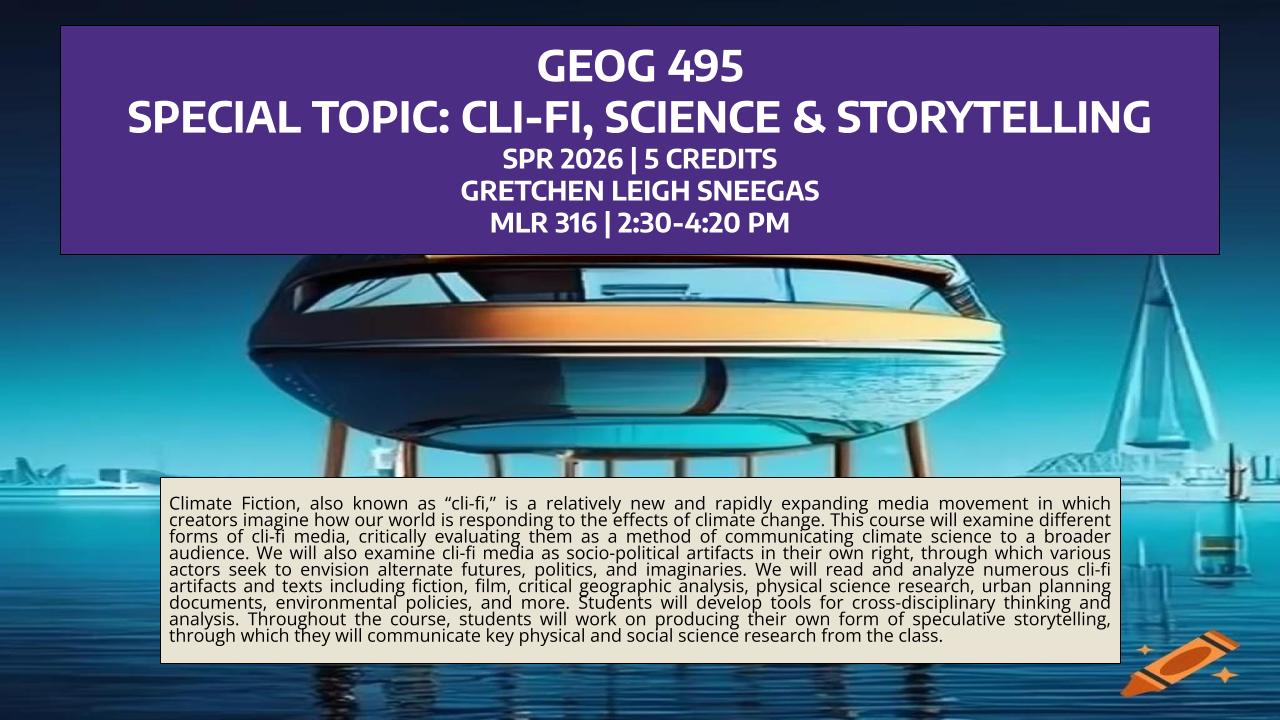
GEOG 495 A: Special Topics in Geography: Climate Change, Science, and Storytelling (5) SSc
Climate Fiction, also known as “cli-fi,” is a relatively new and rapidly expanding media movement in which creators imagine how our world is responding to the effects of climate change. This course will examine different forms of cli-fi media, critically evaluating them as a method of communicating climate science to a broader audience. We will also examine cli-fi media as socio-political artifacts in their own right, through which various actors seek to envision alternate futures, politics, and imaginaries. We will read and analyze numerous cli-fi artifacts and texts including fiction, film, critical geographic analysis, physical science research, urban planning documents, environmental policies, and more. Students will develop tools for cross-disciplinary thinking and analysis. Throughout the course, students will work on producing their own form of speculative storytelling, through which they will communicate key physical and social science research from the class.
View course details in MyPlan: GEOG 495
Kind regards,
Geography Undergraduate Advising
Gina Gould, Sabrina Tatta & Nell Gross
geogadv@uw.edu
Smith Hall 415
Request an Advising Appointment