This last Autumn quarter, the department of political science offered a joint graduate/ undergraduate seminar on the Political Theory of 20th-century Jewish-German thinker - Hannah Arendt. Alongside Political Science students, the seminar drew students from across campus, including students from the departments of communication, Geography, Education, Public Administration, and even Bioethics & Humanities.
Why Are Students Reading Hannah Arendt?
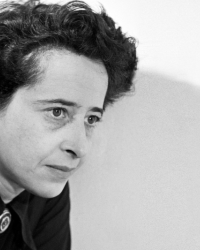
We chatted with Dr. Noga Rotem, an assistant professor in our department and the instructor of the course, to understand the appeal of Arendt’s work for her students.
“As someone whose research focuses on Arendt and who has been fascinated by her work for a long time now, it was a pleasant surprise for me to see how much traction Arendt’s work has with students today,” Professor Rotem said.
“There is certainly a ‘hype’ around Arendt’s work over the last decade,” says Rotem. “Her three-volume work on the rise of totalitarianism in 20th century Europe sold out on Amazon in the aftermath of the 2016 election, and sales increased by over 1000% in the following year. I think that people who stumble onto her work are often really impressed by how prescient she was on many issues.”
Rotem says that Arendt’s writing on fascist movements, on mobs and elites, the masses’ attraction to conspiracies, her critique of Zionism, her account of antisemitism, all seem to be urgently timely and relevant, and resonate with contemporary readers.
“But this is not exactly why I put this seminar together,” Rotem says. “Arendt sees it as a kind of a miracle that even in the most paralyzing and futile political moments people can and do act; and I think that she is right. It is a miracle!”
“What interested me was not so much that Arendt was prescient, but more her unwavering commitment to the idea that even in the darkest of times, people—especially when they work together with others—have the power and the agency to change or repair the world.”
Professor Rotem's Continuing Research
Professor Rotem’s current research focuses on one such context in which Arendt sought to interfere in a bleak political context and energize people to act: her series of articles from the 1940’s about Palestine. In these writings, she warned against Jewish sovereignty in Palestine and advocated for the establishment of a federative system where Jews and Palestinian will “share the world” and co-govern themselves.
“Even though Arendt tragically failed to be effective in the Israeli-Palestinian context—no one cared to listen to her—I am really fascinated by her audacity to dream a political alternative to Palestine/Israel exactly as it is disappearing (with the founding of the state of Israel),” says Rotem; “in what kind of lesson we might learn today from her act of political-dreaming.”