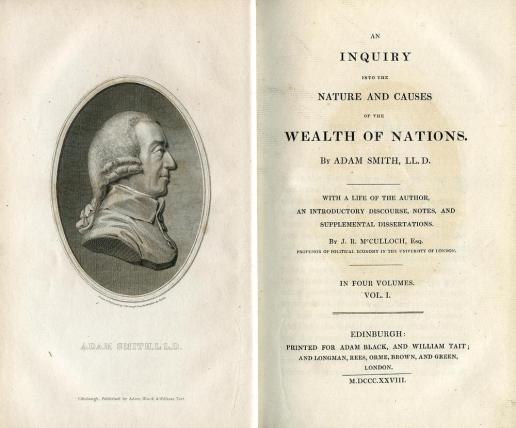
Many are aware of the upcoming 250th anniversary of the US Declaration of Independence. Far fewer, though, know that 1776 was also the year that Adam Smith published An Inquiry into The Nature and Cause of the Wealth of Nations. Not only was Smith’s classic tome foundational for the study of modern economics, but it was also influential in the thinking of the Americal revolutionaries and (eventual) framers of the US Constitution. To celebrate and explore the intellectual relationship between Smith’s Wealth of Nations and the US Framers, three political science faculty applied for an Educational Entrepreneurship Grant from the Institute for Humane Studies to lead a year-long undergraduate reading group focusing on Adam Smith and the influence he played on the likes of James Madison, John Adams, Alexander Hamilton, Thomas Jefferson, Noah Webster, and others.
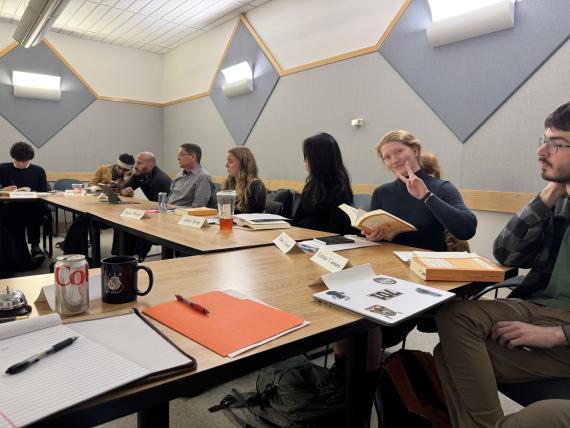
Professors Anthony Gill, James Long, and Victor Menaldo are leading two three-hour discussion sessions each quarter in the 25/26 academic year focusing on specific issue areas that were important in the political economy of the late 18th century and remain salient to this very day. The themes for the fall of 2025 were moral character and the relationship between church and state in a pluralistic republic. Nineteen students chosen from a pool of the best undergraduates in our department’s political economy classes debated these themes vigorously with non-stop conversation moving in directions that even the seasoned faculty did not anticipate. The discussions reflected what these young scholars learned in multiple classes across our department’s curriculum. They also demonstrated that it was possible to engage in respectful conversation on controversial topics amid differences of opinion.
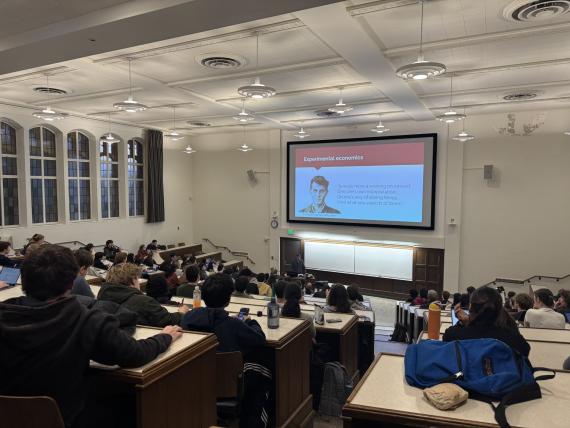
This year-long program also features two guest speakers from outside the UW. The first lecture was delivered by Professor Bart Wilson from Chapman University who spoke about the importance of applying Adam Smith’s other major work, The Theory of Moral Sentiments, to an understanding of the Wealth of Nations and contemporary economic analysis. His lecture was attended by over 100 students, faculty, and members of the public. Professor Wilson then joined in our conversation on the role of religion and politics in the Founding Era the next day. Students received a chance to chat with Professor Wilson and other faculty about their research and ask questions as to how their political economy education can be put to good use beyond the UW.
The upcoming winter and spring quarters will see a continuation of discussion on salient topics such as special interest politics, free trade and tariffs, wealth and inequality, and the role of the judiciary. Another guest lecture is scheduled for May 14th with the speaker to be confirmed shortly.
If you are interested in attending future events, please get in touch with Professor Anthony Gill (tgill@uw.edu) to be put on a list when more information becomes available.